Author: Reuter

Automation of the Bagging Process in Mills – When Is It Worth Making the Switch?

Whether wheat flour, rye flour, meal, grain or animal feed, the bagging process is a key factor in productivity, quality and cost-effectiveness for many mills and compound feed plants.

Increasing production volumes, stringent quality requirements and the growing shortage of skilled labour are presenting the industry with new challenges. At the same time, process reliability, hygiene and cost-effectiveness are becoming increasingly important in packaging operations.

This raises a key question: Is a semi-automatic bagging solution sufficient, or is it time to invest in a fully automatic bagging system? There is no one-size-fits-all answer. The decision depends on production volumes, the product portfolio, staff availability and future production requirements.

This is precisely where TMI and SSB Wägetechnik come in. Through close collaboration between the two companies, customised solutions are developed for the milling, grain and animal feed industries, ranging from precision weighing technology and high-performance bagging systems to complete packaging and palletising lines. The aim is to deliver systems that operate economically and reliably, are designed for the future and can be optimally adapted to individual production requirements.

Automatic or Semi-Automatic Bagging System?

Both semi-automatic and fully automatic bagging systems automatically dose and weigh the product. The key difference lies in how the bag itself is handled.

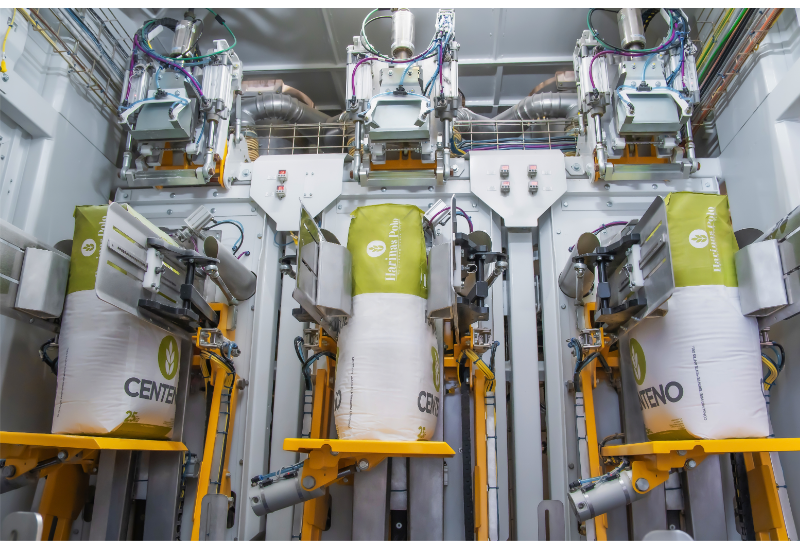
With a semi-automatic system, the operator places the empty bag onto the filling spout. Once filled, the bag is sealed and conveyed onwards. With a fully automatic solution, the system performs every stage of the process, from picking up and opening the empty bag through to filling, sealing and transferring it to the palletising system.

This also changes the role of operating personnel. Instead of carrying out physically demanding, repetitive tasks, their focus shifts to monitoring the process and ensuring that the system is supplied with empty bags and consumables.

Benefits for Mills and Feed Producers

Automation offers significant advantages, particularly when bagging flour, grain, meal or animal feed.

Consistent Line Performance

Automatic systems operate at a consistent speed and with a high degree of repeatability. This increases production capacity and improves planning reliability, particularly where high volumes or multi-shift operation are involved. When filling 25 kg or 50 kg bags of flour, grain or animal feed, a continuous product flow ensures a high level of process stability and improves the utilisation of downstream equipment.

Improved Process and Product Quality

Automatic bag positioning ensures precise filling weights and consistently clean, reliable bag closures. This reduces rework, product waste and downtime.

Improved Working Conditions

Flour and animal feed products are often associated with high levels of dust. Automated bag handling reduces direct contact between operators and the product. At the same time, the physical workload for employees is reduced considerably by minimising repetitive manual tasks

What Requirements Need to Be Met?

A fully automatic bagging system requires a higher initial investment than a semi-automatic solution. Whether this investment is economically viable depends primarily on production volumes, labour costs and the company’s planned growth targets.

In addition, automatic systems require more space due to the additional modules needed for bag feeding and handling. Regular preventive maintenance and appropriately trained operating personnel also play an important role in ensuring high long-term system availability.

When Is Automation Worthwhile?

An automatic bagging system becomes particularly cost-effective when large volumes are being processed and high system availability is required. Automation can also provide a significant competitive advantage in situations where labour costs are rising or skilled workers are difficult to recruit.

For mills and animal feed producers, hygiene and dust control are also important considerations. Reduced manual contact with the product not only improves working conditions but also helps maintain consistently high packaging quality.

Should Bagging or Palletising Be Automated First?

When the available investment budget is limited, the question often arises as to which process should be automated first. Although manual palletising is particularly physically demanding, in many operations the performance of the bagging system determines the throughput of the entire line.

It is therefore advisable to begin by analysing the actual bottleneck. If this lies within the bagging process, automating this stage will generally deliver the greater economic benefit. Palletising automation can then be added as the next logical step.

This is where coordinated system planning offers a particular advantage: bagging technology, conveying systems, palletising and weighing technology are not considered in isolation, but designed as an integrated overall system. This helps reduce interfaces, optimise processes and sustainably improve overall equipment efficiency.

Precision as a Quality Factor

In mills and the animal feed industry, dosing accuracy affects not only product quality but also cost-effectiveness. Even minor overfilling can add up to substantial product losses at high production volumes. At the same time, underfilling must be avoided to ensure reliable compliance with legal requirements and customer specifications.

Modern bagging systems combined with high-precision weighing technology ensure reproducible filling weights, helping to maintain consistently high product quality while improving process control.

Dust Management and Occupational Safety

Bagging flour, meal or animal feed inevitably generates dust. Automated bag handling reduces dust release around the packaging line and consequently improves working conditions.

At the same time, a controlled bagging process makes it easier to comply with hygiene requirements and contributes to a cleaner production environment. Depending on the product and system design, additional dust extraction or explosion protection measures may also be appropriate.

Future-Proof Investment

Many mills modernise their production facilities gradually. When selecting a bagging system, it is therefore important to consider from the outset whether the line can be expanded at a later stage, for example by adding automatic bag feeding, palletising, stretch hood or wrapping systems, as well as digital monitoring solutions.

A modular system concept makes it possible to adapt production capacities to future requirements and spread investment across several stages of expansion.

Conclusion

Whether flour, grain or animal feed, the demands placed on modern bagging processes are continuously increasing. Automatic bagging systems enable higher productivity, consistent packaging quality and improved working conditions.
2 Palettierroboter

Customized Robotics Solution – SSB Wägetechnik Automates Wooden Frame Placement

A key focus of a recent customer project was automating a handling step in the logistics and shipping process that had previously been performed manually. Working closely with the customer, we sought a suitable solution to reliably automate the placement of wooden frames onto palletized Octabins.

The Challenge: The wooden frames lack the characteristics ideal for standard automation; due to their shape and instability, they cannot easily be handled using a standard gripper. Consequently, a solution specifically tailored to this application was required.

Engineering Expertise and Intensive In-House Testing

To address this task, we developed a specialized gripper and conducted extensive in-house testing of the application. During this phase, movement sequences and safe product handling were verified and optimized.

Thanks to rigorous in-house testing, we were able to verify the application’s reliability prior to integration at the customer’s site and fine-tune the processes to meet the specific requirements of the intended operation.

Customized Solution Instead of Standard Technology

The Okura Ai1800 palletizing robot deployed at the customer’s site subsequently handles the automatic placement of wooden frames onto the Octabins, thereby eliminating the need for the previously manual step.

Another advantage of the Okura palletizing robot:

A wide range of high-performance gripper arms is available, enabling safe and efficient handling of a vast array of products. These grippers cover a broad spectrum of applications, ensuring a stable, gentle, and reliably controlled material flow.

This allows the robotics solution to be flexibly deployed for various products within the shipping process, depending on specific requirements.

User Software and Training

In addition to the mechanical solution, application-specific user software is employed. This software enables intuitive operation and supports the flexible use of the robotics solution in daily operations.

As part of our service, we explain the software’s functions and workflows to the customer and provide training on its operation and use. This ensures that employees can use the solution confidently and efficiently during day-to-day operations.

Seamless integration into the logistics process

The robotic solution developed by SSB Wägetechnik was integrated into the customer’s existing logistics and shipping processes. The robot handles the subsequent steps required to prepare the pallets for storage and shipment. Octabins—which have already been loaded and positioned on the pallet—are fitted with a wooden frame. The pallet is then optimally prepared for further logistics steps, storage, or shipping.

Reduced manual labor, greater process reliability

Automation reduces manual effort and relieves employees of repetitive tasks. At the same time, workflows become more efficient, working time is saved, and logistics process performance is boosted. Automated handling also ensures a consistent and reliable workflow.

The project demonstrates how even complex handling tasks can be reliably automated through custom-developed gripper technology, appropriate robotics, and user-oriented software.

Are you facing a similar challenge?

Are you planning a similar automation project or facing a specific challenge with your application? Our experienced SSB Wägetechnik sales and engineering team is here to help you find the right solution.

Would you like to discuss your project with us or get advice on robotics options?

Get in touch with us. Together, we will find a solution that meets your requirements.

We offer training courses and workshops for our Okura robots

In-house Training and Workshops for Okura Robot Systems

Enhanced expertise for efficient system operation

The cost-effective and safe operation of modern palletizing solutions requires qualified personnel and in-depth system knowledge. With its in-house training courses and workshops for Okura robot systems, SSB Wägetechnik GmbH offers practice-oriented training for all users of Okura robot systems.

Naturally, upon purchasing and installing an Okura robot system, our customers receive comprehensive instruction on operating and safely handling the equipment. Furthermore, we offer customized training and workshops for our partners and distributors to specifically deepen existing knowledge, qualify new staff, or cover specialized topics such as operation, programming, maintenance, and process optimization.

The training courses impart comprehensive know-how regarding operation, commissioning, programming, and maintenance, as well as the optimization of palletizing processes. The focus is on the participants’ individual requirements: content, scope, and key areas of emphasis are precisely tailored to the specific systems in use, the respective applications, and the participants’ existing level of knowledge.

Our training courses and workshops offer lasting added value to all participants. They deepen technical expertise, boost confidence in the daily handling of the robot systems, and lay the foundation for efficient, safe, and cost-effective system operation.

By combining theoretical knowledge with practical exercises, participants gain a profound understanding of Okura robot systems. This helps minimize operating errors, reduce downtime, and sustainably increase system performance and availability.

Customized training with measurable added value

With in-house training, companies benefit from targeted knowledge transfer delivered by experienced specialists. These sessions lay the foundation for the safe operation of robot systems and help streamline processes while maximizing the potential of automation.

Your benefits at a glance:

  • Tailored training courses and workshops
  • Comprehensive instruction upon purchase and installation of an Okura robot system
  • In-depth training for new employees and experienced users
  • Practical, hands-on instruction by experienced experts
  • For all users of Okura robot systems
  • Enhanced safety when operating Okura robot systems
  • Optimization of operation, programming, and palletizing processes
  • Increased system uptime and process efficiency
  • Sustainable knowledge transfer for users, operators, and service technicians

Invest in expertise – for maximum performance from your robot systems.

We would be happy to advise you personally on our training and workshop options and work with you to develop a customized training concept perfectly aligned with your requirements and your Okura robot systems.

You are currently viewing a placeholder content from Default. To access the actual content, click the button below. Please note that doing so will share data with third-party providers.

More Information

SSB Wägetechnik and Automation Steel – Join forces for Okura robots in Europe

SSB Wägtechnik and Automation Steel are intensifying their collaboration in the field of palletizing robots and automation solutions. The goal is to significantly expand their joint market presence in Europe and to provide even more targeted support to distributors and system integrators.

The focus is on the use of palletizing robots from the Japanese manufacturer Okura, which have proven themselves worldwide through high speed, precision, and reliability in continuous operation. Okura palletizing robots are used particularly in finishing processes, for example, in the food, chemical, building materials, and consumer goods industries.

Strengthened Partnership for Automation Solutions

By combining the expertise of SSB Wägetechnik and Automation Steel, distributors benefit from clearly structured collaboration and optimized processes. This partnership enables more efficient implementation of robotics projects and direct access to technical know-how regarding modern palletizing solutions.

Services for Palletizing Robotics and Automation
The joint service portfolio includes:

• Planning and implementation of robotics projects
• Development of customized automation solutions
• Wide selection of grippers, robot hands, and end-of-arm tools
• Technical support and project management
• Training and workshops for users and integrators
• Engineering services for customer-specific applications

Benefits for distributors and system integrators

• Clear contacts for Okura palletizing robots
• Direct access to technical expertise
• Fast response times and efficient processes
• Enhanced support for projects and customer inquiries
• Access to proven and high-performance palletizing systems
• Joint development of new market potential

Strengthening the European market together

With this intensified collaboration, SSB Wägetechnik and Automation Steel are consistently expanding their activities in the field of automation and palletizing robotics.

Our goal is to provide long-term support to distributors and partners for the successful implementation of automation projects.

We are always happy to provide you with further information on the responsibilities of individual countries, as well as on projects, solutions and application possibilities of Okura palletizing robots.

SSB and TMI at interpack 2026 – Let’s meet!

Together with our partner TMI, you can find us at interpack 2026 in Hall 12, Booth A67. There, we will present our solutions and discuss current developments and projects in the field of industrial packaging and processing with visitors and partners.

SSB stands for high-performance machines and customized solutions in the areas of bagging technology, palletizing technology, and modern control technology. Our systems are designed to make production processes efficient, reliable, and flexible. From individual machines to integrated system solutions, we support our customers in optimally organizing and improving their production and packaging processes in the long term.

Our partner TMI complements this range of services with its many years of expertise in bagging and palletizing. By combining our technologies and expertise, we create high-performance, comprehensive solutions for modern packaging and production lines. The close collaboration between SSB and TMI enables the optimal integration of machines, automation, and process integration.

At interpack, you’ll have the opportunity to learn more about our machines, technologies, and services. Our sales team will be available throughout the trade fair to discuss current projects and address your individual requirements. We’d be happy to show you how our solutions can contribute to increased efficiency, process reliability, and the future viability of your systems.

If you’re at interpack, please visit us in Hall 12 at Booth A67 or schedule an appointment with our team in advance.

We look forward to engaging in interesting discussions and exchanging ideas with you at interpack 2026!

We never stand still!

Innovative and modern high-performance palletising

  • Low space requirements
  • Innovative processes
  • Flexible in application
  • High performance
  • Significantly lower maintenance costs
  • Fully integrated system automation

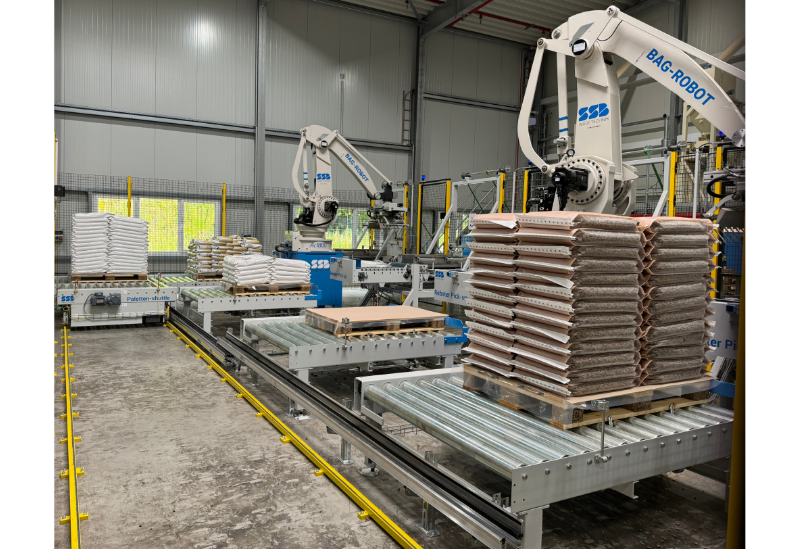
Two high-performance palletisers from SSB Wägetechnik GmbH impressively demonstrate how modern robotics optimises end-of-line processes in the bulk goods industry. In the current customer project in Schkopau, two robots handle the fully automatic palletising of FFS bags at speeds of up to 2,400 bags per hour. This innovative solution replaces conventional palletising systems with significant advantages. Low space requirements, simple format changes, flexible installation options, significantly lower maintenance and downtime costs, and sophisticated process visualisation make this concept a pioneer in modern packaging concepts.

This concept has been further developed in several projects. Thanks to AI-based process optimisations, we are already seeing palletising outputs of up to 3,000 bags per hour.

The process in detail:

Equipped with specially adapted gripping systems, the robots securely pick up each individual bag and position it precisely in the desired pallet pattern. This results in stable, neatly stacked pallets that are ready for further transport. Thanks to flexible programming, different bag formats and pallet layouts can be processed without long changeover times.

The customer project in Schkopau clearly demonstrates the added value offered by the combination of intelligent control technology, robust mechanics and SSB Wägetechnik’s many years of expertise: an efficient, reliable and future-proof palletising process that noticeably reduces the burden on production processes and sustainably increases productivity.

Thanks to modern sensor technology, intelligent image processing and freely programmable controls, palletising patterns can be flexibly adapted. This allows the system to handle different product formats and pallet layouts without long changeover times. High-performance robots achieve cycle rates of several hundred units per minute.

Thanks to the fully integrated Siemens control structure and the integrated machine safety system, we create an easy-to-use and clear interface for the system operator. All external devices such as printers and labellers are controlled centrally. The customer interface for connection to their order systems also simplifies operation and process monitoring.

The most important advantages include:

  • High speed and availability: Robots work continuously, without fatigue and with high precision.
  • Space-saving design: Modern robotic palletisers require less floor space than traditional gantry palletisers.
  • Improved occupational safety: Heavy lifting operations are fully automated, minimising the risk of injury.
  • Cost efficiency: Lower personnel costs, less waste and optimised processes often mean that the investment pays for itself quickly.

Packaging systems in the agri-food industry

The Key to the Optimal Filling and Packaging Line

The production of premixes, vitamins, additives, and functional ingredients for the agricultural and food industries is characterized by a wide variety of products, small batch sizes, and diverse material properties. This complexity directly impacts the filling process, packaging, and palletizing. A high-performance, flexible, and hygienic packaging solution is therefore crucial to ensuring consistent quality, safety, and cost-effectiveness.

Key Factors for Designing an Efficient Filling Line

Material and product properties:

Depending on the structure – pellets, granules, or fine powders – dosing and weighing systems vary considerably. Powdered products require dustproof systems, extraction systems, airtight or breathable bags, and venting or compaction solutions for stably filled bags and their closure.

Packaging and transport logistics:

Selecting the right pallets and packaging materials to protect against contamination, moisture, or other environmental influences, as well as pallet stability and transport safety, is also a crucial criterion. Suitable packaging and side protection prevent damage and avoid returns.

Product diversity and batch management:

Many formulations and frequent product changes increase cleaning effort and downtime. Rapid changeovers, tool-free accessibility, and hygienic design are required to prevent cross-contamination.

Hygienic design, maintenance access, and user-friendliness:

Food and feed processing require clean, easy-to-clean machine surfaces and readily accessible areas. Fast and thorough cleaning reduces downtime and increases plant availability.

Space Requirements and Plant Layout:

When creating a plant layout, the available space at the customer’s site must be taken into account. This is straightforward with a greenfield solution (new construction). Here, the existing building structure can be adapted to the plant design. However, plants usually have to be integrated into existing environments, which presents a significant challenge and demands considerable flexibility.

Case Study: Automated Complete Solution for Pet Food Packaging

A manufacturer of powdered pet food additives originally filled its products manually into aluminum and PE bags. The process was labor-intensive, limited output, and made stable palletizing difficult. To automate the process, SSB Wägetechnik, in collaboration with TMI, developed an integrated bagging and palletizing system. Following laboratory analyses of the products’ density, flow properties, and dosability, a compact solution was developed. The Ilersac H/HC automatic bagging machine handles filling, venting, and sealing, while the Ilerpal H hybrid layer palletizer ensures stable palletizing. Finally, the Ilergir stretch wrapping machine and Ilerbox cardboard side pallet protection protect the pallets for transport.

All process steps—from precise weighing, filling, sealing, weight control, and rejection to palletizing, wrapping, and side protection—are automated in an area of ​​approximately 75 m². The hygienic machine design reduces dust emissions, simplifies cleaning, and significantly increases uptime.

The result: A compact, flexible, and hygienic overall solution that increases productivity, reduces downtime, and enables a safe and economical packaging line for a wide variety of food and feed ingredients.

Solids Trade Fair – We will be there as always!

On 18 and 19 March 2026, Solids Dortmund, the trade fair for granulate, powder and bulk solids technologies, will celebrate its 20th anniversary. The 9th edition of Recycling Technology will take place at the same time. In four halls, exhibiting companies will present technologies and solutions for the bulk solids, process and recycling industries.

And SSB Wägetechnik will be there for the 17th time!

“For almost two decades, Solids Dortmund has been an integral part of our trade fair calendar – and an indispensable part of our annual planning.

The personal atmosphere and valuable contacts make it unique,” emphasises Ulrich Korn, Managing Director of SSB Wägetechnik GmbH.

In addition to the participation of numerous renowned companies, the anniversary edition will focus on knowledge transfer, innovative developments, and new trade fair formats.

SBB Wägetechnik is proud to have been involved for so long and is already looking forward to a successful participation with a magnificent stand in a prime location.

You will find us here: Hall 5, Stand N12

Come and visit us and let us surprise you!  We have a hot coffee waiting for you and some new products to show you 😉

Secure your free trade fair ticket now!

Online registration for Solids & Recycling Technology Dortmund on 18 and 19 March 2026 is now open. You can get a free trade fair ticket from SSB Wägetechnik here.

Two strong partners. One smart solution!

It’s that time again – from 23 to 25 September 2025, the packaging industry will meet at Powtech/FachPack in Nuremberg and SSB Wägetechnik and TMI will be right in the middle of it together!

You can expect concentrated expertise and pioneering solutions for weighing, filling and packaging bulk goods.

SSB Wägetechnik brings decades of experience, technical precision and smart automation solutions to the table. From the first gram accuracy to complete integration into your logistics processes.

As an international specialist in packaging technology, TMI sets new standards in bagging, palletising and end-of-line packaging.

The close cooperation between the two companies enables automated process chains for a wide range of industries, tailored precisely to your requirements.

What can you expect on site?

🔹 Personalised advice from our expert teams
🔹 Innovative machines
🔹 A relaxed atmosphere for good discussions

Are you curious to find out more?

We cordially invite you to our stand!
POWTECH/Fachpack 2025 – Hall 9, Stand 450.

New Year, New Opportunities

When we look back, we see more than just numbers and milestones – we see achievements we have accomplished together. We started 2025 full of energy and immediately set the course for exciting new projects. New partnerships, fresh ideas, and a clear focus on innovation and growth.

Our milestones in 2024… more to follow… 😀 💪

Contact us.

Privacy Policy

© All rights reserved.